A Eulogy for Imperial Hypocrisy: Haiti, Cynicism, and the Promise of Progress
How Cynical Empire Destroys the Conditions for Political Progress
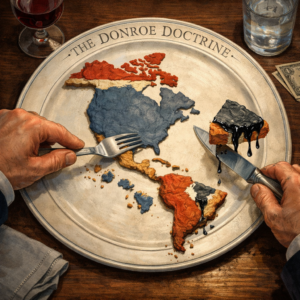
From time to time, the imperial temptation returns wearing the mask of necessity. Haiti (among many other countries and regions at risk of political dissolution, from Mali to Sudan to Venezuela to Iran) has brought it back again.
As gang violence has engulfed Port-au-Prince and the Haitian state has all but collapsed, some Haitian political figures—exiled, embattled, or desperate—have openly called for renewed international intervention. The argument is not hard to understand. Haiti is in a humanitarian and political catastrophe, much of it produced by centuries of external extraction, imposed debt, and foreign meddling layered atop domestic dysfunction. Order, any order, begins to look like salvation.
This is the moment when arguments for renewed imperial governance begin to sound less outrageous than they once did. If a state cannot govern itself, if sovereignty produces only violence and paralysis, why not hand the reins back to someone who can impose order? Why not acknowledge, at last, that the postcolonial experiment has failed in some places—and that external rule, however distasteful, might be preferable to chaos?
Haiti, tragically, seems to offer itself as Exhibit A.
But the danger of this argument does not lie primarily in its diagnosis. Haiti is in ruins. The danger lies in the historical moment in which the remedy is being proposed. A return to empire today would not revive an old liberal hypocrisy. It would inaugurate something colder: empire without hypocrisy, and therefore without the internal contradictions that once made moral and political resistance possible.
To see why, it helps to return to the last time the United States ruled Haiti directly.
When American Marines landed in 1915, the official justification was stabilization. Haiti was politically volatile, economically constrained, and feared by U.S. policymakers as a potential site of European intervention. The occupation promised order, fiscal responsibility, and the restoration of democratic institutions.
What it delivered instead was a racially inflected regime of extraction and control. Under Woodrow Wilson, the United States stayed far longer in Haiti than in the neighboring Dominican Republic, rewrote Haitian law to allow foreign land ownership for the first time since independence, centralized power in Port-au-Prince, and governed largely in the interests of U.S. banks, agribusiness, and extractive firms. Peasant resistance—most famously the Cacos uprisings—was met with brutal repression, leaving thousands dead and seeding a radicalized critique of imperial domination that would echo through the twentieth century.
It was an occupation steeped in hypocrisy. The language of order masked racial hierarchy. The promise of uplift concealed expropriation. The rhetoric of guardianship belied a profound contempt for Haitian sovereignty.
And yet, that hypocrisy mattered.
In Jonathan Demme’s documentary The Agronomist, the Haitian journalist and agronomist Jean Dominique recounts a childhood memory from the occupation years. Seeing American soldiers arrive, young Dominique was impressed by their uniforms and bearing. He smiled and began to wave. His father stopped him, placing a hand on his shoulder. Do not do that, he warned. Never smile at them. You are not French. You are not British. You are not American. You are Haitian. Your ancestors fought at Vertières.
The moment is small and tender. But it captures something essential. The American occupation did not arrive declaring itself an empire of domination, but rather claiming to spread order, progress, and responsibility. That claim—false as it was—required Haitians to remember who they were in order to resist what was being done to them.
Hypocrisy did not redeem empire. But it created a moral discrepancy—a gap between what power claimed to be and what it actually was. That gap became a wedge. It was where political identity formed, where memory hardened, where resistance found its language.
Jean Dominique’s later life—as a defender of Haitian democracy, a relentless critic of dictatorship and foreign interference, and ultimately a martyr assassinated for refusing silence—can be read as the long political afterlife of that formative contradiction. Hypocritical empire forced the articulation of dignity.
This dynamic was not unique to Haiti. It also animated the uneasy relationship that Frederick Douglass, late in life, developed with American power in the hemisphere.
By the late nineteenth century, the United States was no longer merely a republic preoccupied with continental expansion. It was becoming a hemispheric power, increasingly entangled in the Caribbean and Central America, and newly confident that its institutions, markets, and moral vocabulary could travel. Douglass—former slave, abolitionist prophet, and eventually U.S. minister to Haiti—was fully aware of the danger. But he did not respond by rejecting American power outright. Instead, he tried to bind it to its own highest claims.
This choice has made later readers uneasy. Why would the most penetrating critic of American racism place any faith in the nation’s international role? Why would a man so attuned to domination imagine that U.S. influence could serve liberation beyond its borders?
Part of the answer lies in Douglass’s lifelong refusal to surrender the language of progress. He understood American hypocrisy intimately; he had made a career of exposing it. But he also believed—against mounting evidence—that hypocrisy was preferable to candor without conscience. As his biographer David Blight has written of Douglass’s engagement with Haiti, he “still believed, against the tide, that Haiti was a place where those impulses could be tamed or restrained and made into a force for freedom.”
This was not naïveté. Douglass knew that the United States did not seek influence abroad in order to liberate the oppressed. He was too seasoned a political actor for that. But he believed—perhaps stubbornly—that self-interest and emancipation could sometimes move in the same direction, and that when they did, moral pressure mattered.
What Douglass feared more than imperial hypocrisy was imperial indifference.
In speeches and essays throughout the 1880s and 1890s, he returned again and again to the idea that a nation’s greatness was inseparable from its capacity for moral self-correction. “The best friend of a nation,” he wrote, “is he who most faithfully rebukes her for her sins.” That formulation only makes sense if the nation still claims to have sins at all—if it still professes standards it can be accused of betraying.
Douglass’s hemispheric vision rested on that fragile assumption. He imagined an America whose expanding influence might—under pressure, under rebuke, under relentless critique—be bent toward freedom rather than domination. Haiti mattered to him not because it needed American tutelage, but because it stood as proof that Black sovereignty and republican self-rule were possible in the modern world.
History, of course, was not kind to this hope. The twentieth century would show just how easily American power could abandon moral restraint when race, capital, and control aligned. But Douglass’s wager was not that the United States was virtuous. It was that virtue could still be demanded of it.
That wager depends on hypocrisy.
What distinguishes the contemporary revival of imperial talk is not merely its crudeness, but its cynicism.
When Donald Trump muses about annexing Greenland, seizing Venezuelan oil, sending U.S. troops into Mexico, or—most starkly—absorbing Canada as a fifty-first state, the rhetoric does not pretend to civilize or uplift. Canada is not a failed state. It is a stable democracy, a treaty ally, and a neighbor bound to the United States by dense economic, social, and cultural ties. To speak of annexation here is not imperial improvisation in a vacuum of governance; it is domination contemplated openly, even playfully.
That playfulness matters. Outrageous schemes rarely arrive fully formed. They are floated as jokes, normalized through repetition, and tested for resistance. Trumpist imperialism does not cloak itself in humanitarian concern or developmental promise. It speaks transactionally—of profit, leverage, access to resources, and geopolitical advantage. Sovereignty becomes negotiable. Territory becomes a deal.
It is no accident that this posture has been framed, approvingly in some quarters, as a “Donroe Doctrine”—a knowing distortion of the Monroe Doctrine that once warned European empires away from the Western Hemisphere, but now signals something closer to proprietorship than protection. What drops out in the transition is not only restraint, but pretense.
This is not hypocrisy. It is cynicism.
Hypocritical empire lies about its motives while still invoking ideals it cannot meet. Cynical empire dispenses with ideals altogether. It does not claim to rule for others’ benefit. It does not promise progress, order, or moral improvement. It asks only: What do we get? Who wins? Who loses?
Here, the distinction that the historian Timothy Snyder draws between the politics of inevitability and the politics of eternity becomes decisive. The liberal belief—however complacent—that history bends toward improvement is replaced by a vision of permanent struggle, zero-sum domination, and endlessly replayed grievance. Power is no longer justified by reference to a better future. It is justified by its own exercise.
This shift matters because politics depends on contradiction. Hypocrisy creates friction between promise and practice. That friction generates critique, movements, memory, and reform. Cynicism dissolves the contradiction by abandoning the promise altogether.
This is why the renewed appeal of imperial “solutions”—including arguments to resurrect colonial governance for broken states—is so dangerous in the present moment. Even where the diagnosis is not wrong, the remedy assumes a moral world that no longer exists. Colonial administrations, for all their violence and racism, justified themselves through a vocabulary of development and trusteeship. Those claims were hypocritical. But they were also constraints. They generated critics, dissidents, and eventually anti-colonial movements that spoke in the master’s moral language against the master himself.
To “go back” to empire now would not resurrect those hypocrisies. It would institutionalize cynicism as a governing principle—rule without alibi, domination without shame, power without a future-oriented claim.
Empires have always lied about themselves. Those lies were not incidental. They were the price of entry into a moral universe in which power still felt compelled to justify itself. That universe is now fading.
The danger of our moment is not that we will repeat the sins of liberal empire. It is that we will do so without even the hypocrisy that once made those sins contestable. If progress once depended on exposing false promises, we should ask what happens when the promises disappear. And if political power no longer even pretends to define a shared future, we may soon find that “progress” is being defined elsewhere—by those who control platforms, technologies, and systems that claim inevitability of their own.
That is a question for another essay. But it is one we will not be able to avoid for long.