In defense of American hypocrisy: Trump, cynicism, and the possibility of progress
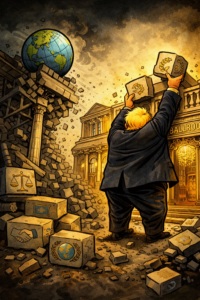
When the Trump administration speaks of “peace” in the Democratic Republic of Congo, it does so with a striking bluntness. There is little pretense of multilateralism, international law, or the slow political work of reconciliation. Peace is framed instead as a transaction: stabilize the region enough to secure access to strategic minerals, guarantee supply chains, and reward cooperation. Justice is incidental. What matters is whether the deal closes.
Many critics respond with a weary shrug reminiscent of Noam Chomsky. What’s new? The United States, they remind us, has always intervened abroad in pursuit of its own interests. International law has always been selectively applied. From Congo to Iraq to Guatemala to Vietnam, American power has repeatedly violated the ideals it professes. Trump, on this view, merely strips away the hypocrisy and says the quiet part out loud.
The appeal of this argument is understandable. It flatters our historical sophistication (“I have read and appreciated Howard Zinn”) and spares us the discomfort of moral reckoning. But it misses what is genuinely dangerous about the present moment. The problem is not that Trump reveals American power to be self-interested. The problem is that he treats the very idea of higher standards—law, universality, aspiration—as obsolete.
What earlier administrations violated, Trump discards. And that difference is, in my opinion, a kind of philosophical Rubicon.
Hypocrisy Is Not the Same as Cynicism
The United States was born in hypocrisy. The Declaration of Independence proclaimed universal equality while tolerating slavery, dispossession, and racial hierarchy. It was motivated in part by the British Crown’s unwillingness to permit westward settlement beyond the Appalachian Mountains — settlement that would soon entail genocide and ethnic cleansing on a continental scale.
This history is not a footnote, but foundational. But hypocrisy, however damning, is morally unstable. When a society publicly commits itself to ideals it fails to uphold, it creates leverage against itself. Those ideals can be — and historically were — used by abolitionists, suffragists, civil rights activists, and Indigenous leaders to force the expansion of the moral community. The gap between principle and practice became a site of struggle — a delta that, with moral labor, yielded moral progress.
Hypocrisy contains the possibility of reform. Cynicism does not.
Cynicism declares that there are no real principles — only interests, only Thrasymachean power, only friends and enemies. Where hypocrisy says “we fall short,” cynicism says “this is all there ever was.” It is the difference between failure (with the possibility of “failing forward”) and foreclosure.
From Inevitability to Eternity
This distinction helps clarify what is at stake in what Timothy Snyder has described as the slide from a “history of inevitability” to a “history of eternity.” For much of the postwar period, American political culture — often complacently — assumed that liberal democracy, rule of law, and expanding rights were the natural direction of history. This belief obscured injustice and suffering, but it also anchored politics to a future-oriented moral horizon.
As that belief collapses, it is increasingly replaced by a darker frame: the idea that nothing really changes, that politics is an endless cycle of threats and enemies, that ideals are childish myths. Autocrats thrive in this temporal landscape. If history endlessly repeats, there is no reason to aspire — only to dominate as we did before.
What is under assault here is not merely progressive policy, but the philosophical foundations of progressivism itself: the belief that history can move in a morally meaningful direction, that institutions can be refined, and that future-oriented standards can legitimately judge the present.
This is why comparisons meant to reassure — Trump as Andrew Jackson, Trump as James Monroe — land so differently than intended. If we must reach back to the 1830s — to the Second Creek War, slavery, lawless expansion — to find presidential analogues, then something has gone profoundly wrong. Either the idea of progress was always a comforting fiction, or it was real and we are now deliberately dismantling it.
Trumpism quietly opts for the first conclusion. By insisting that “this is how it has always been,” it dissolves the very notion of moral advancement. The point is not merely that we have failed to progress, but that progress itself is dismissed as naïve — an embarrassment best outgrown. This is the slide from hypocrisy to cynicism: from falling short of ideals to denying that ideals can or should exist at all.
Power Without Pretense
Trump’s own words make this shift unusually explicit. In a New York Times interview, he was asked what would restrain his behavior as president if not international law or institutional checks. His answer was chilling in its simplicity: only his “own morality”.
This was no gaffe, but a declaration. Law, norms, treaties, and institutions were cast not as constraints, but as optional accessories — irrelevant unless voluntarily honored by the powerful. The implication is stark: there is no external standard to which power is answerable. There is only a will to power. This is the same heady Nietszchean stuff that animated the Third Reich.
Earlier American interventions abroad were often brutal and illegal, but they were still cloaked in the language of universality: democracy, human rights, international order. These justifications were frequently hypocritical, sometimes grotesquely so—but they kept the grammar of moral accountability alive. Trump dispenses with the grammar altogether. Who cares about genocide when a Trump resort can be erected on their graveyard?
The Lure of Strongman “Success”
This is why appeals to strongman effectiveness are so seductive — and so dangerous.
Consider Venezuela. Nicolás Maduro is a tyrant responsible for repression, disappearances, torture, and economic collapse. Trump has claimed credit for securing the release of political prisoners and for cowing the regime through pressure and threats. Many Venezuelans welcomed any leverage that weakened Maduro’s grip. It would be foolish to deny that coercive diplomacy can sometimes yield real, tangible benefits.
Iran presents a similar temptation. The regime faces mass protest fueled by economic mismanagement, brutality, and political exclusion. Trump’s threats, combined with Israeli strikes, the impoundment of “shadow fleet” oil tankers leaving Venezuela (see above), and regional pressure, may well have contributed to destabilizing an authoritarian government that deserves no romantic defense. Results matter.
But here is the crucial distinction. In earlier eras, such actions were at least rhetorically justified in universal terms. Trump does not claim to defend rights as such. He claims to win. And winning, in this frame, is indistinguishable from domination.
Hypocrisy Then, Gangsterism Now
This helps explain the coherence — rather than the contradiction — of Trump’s domestic and foreign posture. While claiming credit for the downfall or destabilization of foreign tyrannies, his administration has responded to protest at home with militarized force, threats, and contempt for constitutional restraint. The message is consistent: authority is to be obeyed, not justified.
Foreign tyrants are objectionable not because they violate universal principles, but because they are enemies of one man. Domestic dissent is intolerable not because it is violent (it often is not), but because it challenges one man’s power. There is no contradiction to resolve, because there is no standard above power itself.
This is not hypocrisy of the old kind. It is not the tragic failure to live up to ideals. It is their abandonment in favor of a rough gangsterism that recognizes only loyalty and force.
The Return of Shame
One underappreciated casualty of this shift is shame.
Much of the contemporary Left has sought — often for good reasons — to excise shame from social discourse. Shame has been used to police gender and race identities, enforce conformity, and justify cruelty. But shame is also one of humanity’s oldest (indeed, genetically encoded) tools for sustaining prosocial behavior. It only becomes toxic when severed from ethical aspiration.
Earlier American hypocrisy still presupposed the capacity for shame. Power concealed its violence, cloaked its interests in moral language, and offered justifications — even bad ones. This was not virtue, but it was evidence that power still recognized standards beyond itself.
Trumpism rejects even this. It does not merely violate norms; it mocks the idea that norms should matter. It replaces embarrassment with bravado. It replaces justification with taunting. It replaces accountability with spectacle. This is shamelessness, not honesty.
A politics without shame is not liberated, but rather unteachable, incorrigible. And a society that cannot be ashamed of its failures cannot aspire to be better than it is.
Why the Distinction Matters
Those who say “America was always like this” are not wrong about the past. They are wrong about the danger of the present.
A hypocritical empire can still be pressured, shamed, reformed, and constrained. A cynical one cannot. When power stops pretending it owes explanations, when it no longer even performs allegiance to universality, it licenses the same move everywhere else. Why respect borders? Why honor treaties? Why restrain violence if restraint is for fools?
This is how international order doesn’t merely erode — it becomes unintelligible.
The tragedy is not that America fails to be what it claims. The tragedy is that it increasingly claims to be nothing more than what it is at its worst.